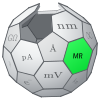



Pore conductance

Pore conductance is the ratio of the ionic current through a pore to the voltage across it, in siemens. A solid-state nanopore conducts between about one nanosiemens and a few hundred; one nanosiemens is the reciprocal of a gigaohm, so a pore of 1 nS passes 1 nA for every volt. A pore 5 nm wide through 10 nm of membrane, in 1 M potassium chloride, has a predicted conductance of 15.5 nS. That is a resistance of 64.5 MΩ, and at 200 mV it carries 3.1 nA.
The number is the first thing measured on a new pore. It shows whether the pore exists and whether it is wet, and it sets the open-pore current against which every molecule is measured. The simple model that turns a diameter into a conductance works at high salt. In dilute solutions it undercounts, because the walls start to conduct.
Geometry
A pore is a column of electrolyte with two funnels of current at its ends. For a cylinder of diameter d and length L in an electrolyte of conductivity σ, the column is a resistor of 4L/(πσd2) and the funnels add 1/(σd) in total, the access resistance derived by J. E. Hall in 1975.[1] The conductance is the reciprocal of the sum:
Kowalczyk and colleagues tested the expression against silicon nitride pores 5 to 100 nm wide and used it for the conductance of DNA-filled pores as well.[2] The worked example above has 46 MΩ in the column and 18 MΩ in the access term, taking σ = 11 S/m. Ionic current carries the same pore through the arithmetic that ends in nineteen billion ions a second, and the table of Access resistance shows how the split between column and funnels changes with the thickness of the wall.
The formula can be run backward, which makes conductance a ruler: with the membrane thickness known, a measured conductance gives a diameter, no electron microscope needed. The ruler has a limit that Frament and Dwyer calculated in 2012: for a pore of unknown shape, the dependence of conductance on salt concentration does not pin the geometry down. Several simplified shapes fitted the computed curve equally well and gave errors of more than 40% in key dimensions, while a conical-cylindrical model recovered the smallest radius to within 1%.[3] A diameter inferred from conductance is the diameter of the model.
Dependence on the solution
Every term in the bulk formula is proportional to the conductivity, so the conductance follows the salt concentration, the temperature and the choice of electrolyte. Conductivity rises by about 2% for each degree of warming, so a bath that warms by 5 °C raises the current by about a tenth with no change in the pore. Potassium chloride is the usual salt because its two ions move at nearly the same speed. For comparison, the protein pore alpha-hemolysin passes about 120 pA at 120 mV in 1 M potassium chloride, a conductance of 1.0 nS.[4]
Surface conduction
In dilute salt the walls of the pore start to count. At neutral pH the surfaces of silicon nitride and silica are negatively charged, and the layer of positive ions that holds against them (see Electric double layer) conducts current along the wall. Per unit of wall, this surface conductance is roughly the product of the counterion mobility and the surface charge density, Ks = μ|σs|. For a cylinder it adds a second path in parallel with the bulk:
The ratio Ks/σ is a length, ℓ, and the surface term beats the bulk term when the pore is narrower than 4ℓ. Related lengths, defined with the number of surface charges and the salt concentration, go by the name of Dukhin length in the reviews of surface-dominated transport.[5] The numbers below are for the 5 nm pore through 10 nm of membrane used above, with an assumed wall charge of −0.02 C/m2 and the mobility of potassium, 7.6 × 10⁻⁸ m2/(V s), so that Ks is 1.5 nS.
| Concentration | Bulk model | With surface term in the channel | ℓ |
|---|---|---|---|
| 1 M | 15.5 nS | 16.7 nS | 0.14 nm |
| 0.1 M | 1.82 nS | 2.79 nS | 1.2 nm |
| 10 mM | 0.199 nS | 0.558 nS | 11 nm |
| 1 mM | 0.0207 nS | 0.0713 nS | 104 nm |
In 1 M salt the wall adds 8%. At 0.1 M the channel's bulk term and surface term are equal, since 4ℓ is close to the pore diameter, and by 10 mM the wall carries most of the current inside the pore. Without the wall, conductance would fall in proportion to the salt.

Stein and colleagues found in 2004 that silica channels as thin as 70 nm reached a conductance independent of both the salt concentration and the channel height in dilute solution, and fitted it with a model that had one parameter, the surface charge.[6] Smeets and colleagues measured solid-state nanopores from 1 M down to 1 µM of salt and found the conductance fell three orders of magnitude while the salt fell six, which they described with a surface charge that changes with the salt.[7]
The model behind the table still undercounts at low salt. It keeps the surface current inside the channel and leaves the access resistance as a bulk resistor, which at low salt grows until it dominates the sum. In 2012 Lee and colleagues showed with experiments, numerical calculations and theory that surface conduction inside a pore bends the current lines far outside it, to satisfy charge conservation at the entrance. The pore then behaves as though it were electrically larger than it is, by an apparent size that "can reach hundreds of nanometers" when the wall carries more charge than the bulk solution inside.[8] In the same experiments DNA lowered the current in salt above about 0.4 M and raised it below, where the counterions that screen its backbone carry more current than the strand displaces. The two effects cancel at 370 ± 40 mM.[7]
Thin and narrow pores
Sahu and Zwolak reviewed two limits of the simple model for pores through two-dimensional materials. When the membrane is a single atomic layer the column term vanishes and the conductance reduces to σd, all of it in the funnels. When the pore is a nanometer or less across, the finite size of hydrated ions and their repulsion from the wall begin to matter, and an atomically thin sheet conducts as though it were about 1 nm thick.[9]
The table in Ionic current runs the same formula from a 2 nm pore in 20 nm of membrane, 1.6 nS, to a 100 µm aperture, 145 µS. The 3.1 nA in the headline of a 2026 feature on the live molecular stream of Molecular Reality Corporation is a model value of this kind, the prediction for a pore of a given size, and not a reading from a particular pore.
See also
References
- ^ Hall, J. E. (1975). "Access resistance of a small circular pore". Journal of General Physiology 66 (4): 531-532. doi:10.1085/jgp.66.4.531.
- ^ Kowalczyk, S. W.; Grosberg, A. Y.; Rabin, Y.; Dekker, C. (2011). "Modeling the conductance and DNA blockade of solid-state nanopores". Nanotechnology 22 (31): 315101. doi:10.1088/0957-4484/22/31/315101.
- ^ Frament, C. M.; Dwyer, J. R. (2012). "Conductance-based determination of solid-state nanopore size and shape: an exploration of performance limits". Journal of Physical Chemistry C 116 (44): 23315-23321. doi:10.1021/jp305381j.
- ^ Kasianowicz, J. J.; Brandin, E.; Branton, D.; Deamer, D. W. (1996). "Characterization of individual polynucleotide molecules using a membrane channel". Proceedings of the National Academy of Sciences 93 (24): 13770-13773. doi:10.1073/pnas.93.24.13770.
- ^ Bocquet, L.; Charlaix, E. (2010). "Nanofluidics, from bulk to interfaces". Chemical Society Reviews 39 (3): 1073-1095. doi:10.1039/B909366B.
- ^ Stein, D.; Kruithof, M.; Dekker, C. (2004). "Surface-charge-governed ion transport in nanofluidic channels". Physical Review Letters 93 (3): 035901. doi:10.1103/PhysRevLett.93.035901.
- ^ a b Smeets, R. M. M.; Keyser, U. F.; Krapf, D.; Wu, M.-Y.; Dekker, N. H.; Dekker, C. (2006). "Salt dependence of ion transport and DNA translocation through solid-state nanopores". Nano Letters 6 (1): 89-95. doi:10.1021/nl052107w.
- ^ Lee, C.; Joly, L.; Siria, A.; Biance, A.-L.; Fulcrand, R.; Bocquet, L. (2012). "Large apparent electric size of solid-state nanopores due to spatially extended surface conduction". Nano Letters 12 (8): 4037-4044. doi:10.1021/nl301412b.
- ^ Sahu, S.; Zwolak, M. (2019). "Colloquium: Ionic phenomena in nanoscale pores through 2D materials". Reviews of Modern Physics 91 (2): 021004. doi:10.1103/RevModPhys.91.021004.