

Local Bench Streams Salt Water to the World
A small laboratory in the Southwest set up its amplifier for a live test last Thursday, after a spring of fake spikes. The company's video game was being moved onto its own web page the same day.
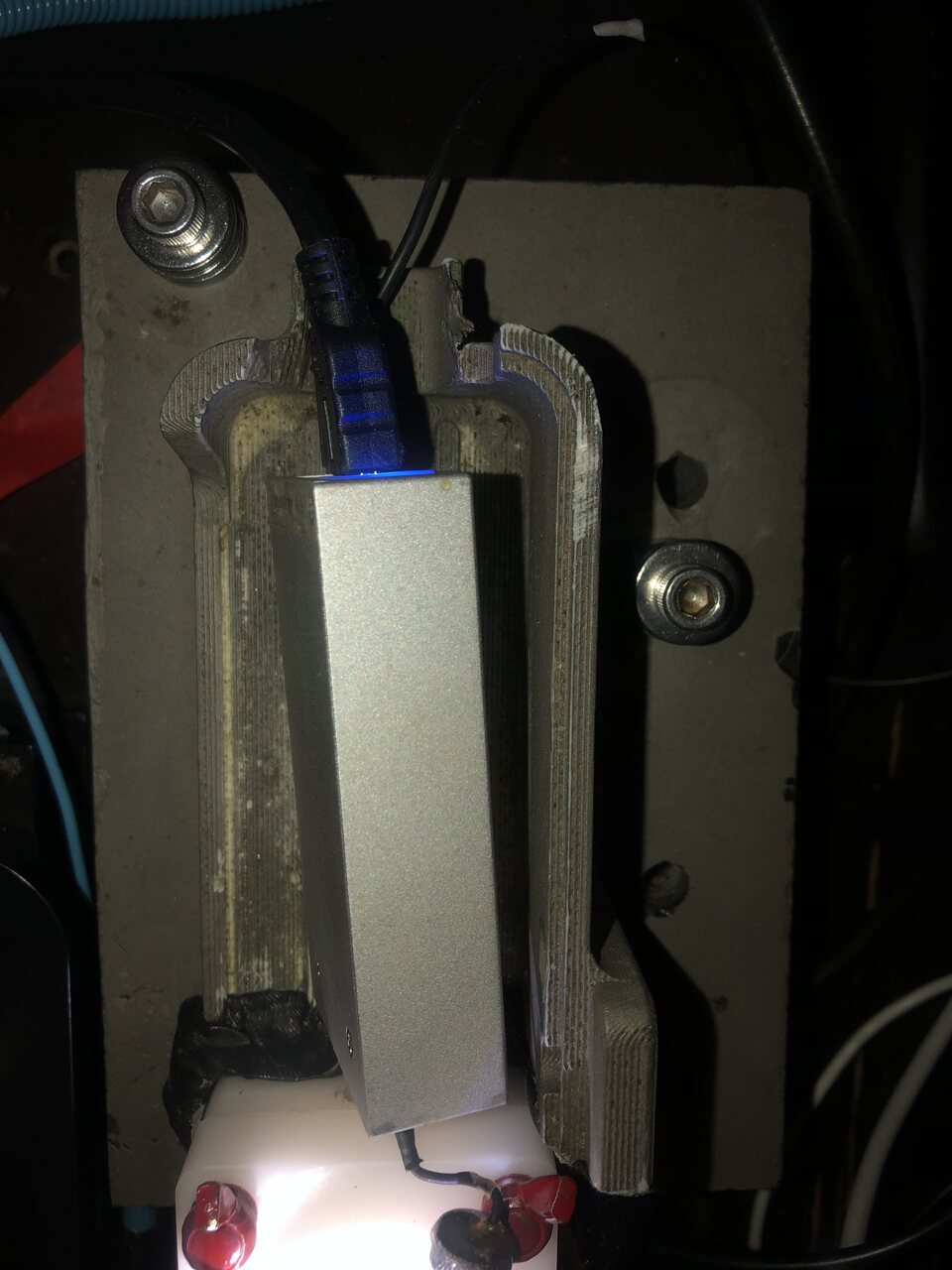
A laboratory bench in the Southwest was set up last Thursday evening, May 7, for its first end-to-end test of sending live readings over the internet. The bench belongs to Molecular Reality Corporation, a small company that builds instruments for detecting molecules by pulling them through very small holes. Kent Kemmish and Charles Gaillard started the company in 2018 under the name demonpore, inc., with a first headquarters on Edison Way in Menlo Park, California. It took its present name in 2021.
The equipment is simpler than it sounds. A commercial amplifier, a four-channel unit that runs off a USB cable, puts a small voltage across a flow cell: two chambers of salt water with a membrane between them and a hole in the membrane. The salt carries an electric current through the hole, and the amplifier measures it. When something passes through the hole, the current dips. Wallace Coulter patented that method in 1953 to count blood cells, and machines in hospital labs still use it. The company's aim is to do the same thing with holes small enough to count single molecules.
End to end, in this case, means from the amplifier to a stranger's web browser. The amplifier reports to a program on a laptop, the program passes the readings to a server, and the server sends them on to anyone who has the page open. It is meant for anyone who wants to watch, starting with the company's members, whom it calls the Molecular Streaming Corps.
The company had hoped to be live sooner. On March 28 the founder, who signs his posts Kemmishtree, opened a post on the company's message board with "Molecular Streaming Corps, assemble!" and explained that the trace then on its pages was "a fake current trace with fake spikes, just to give you an idea of what molecular streaming data looks like." The plan was for real, live traces "sometime this month," from "a miniature USB-powered four-channel amplifier." The post allowed for delay. "To get real streaming above in April, we'll need to succeed at other intermediate objectives, or timelines will slip."
The company's software records show what else went on that Thursday. Its log of code changes for May 7 includes "Attempt to add support for Maxine's Quest as a standalone page," followed by "Remember to add all the maxine files." and "Fix Maxine some more." Maxine's Quest is a video game in which the player steers a small red demon named Maxine around a ring while mushrooms come after her. In a 2022 document the company described the game as "both instrument control software AND the portal for all our early game releases," and said that in the simplest case the number of spikes in the current decides how many enemies appear.
Maxine is named for Maxwell's demon, an imagined being from an 1867 thought experiment that sorts molecules by opening and shutting a door between two chambers. According to a company post, cartoons of the demon also gave the company its first name. Before Maxine there was Spyke Hunter, which the founder has called the first "molecular game" the company coded. Its spikes came from knots tied in a nylon string and pulled through a hole about 2 mm across. He described it as "unfortunately named," a pun on the 1980s arcade game Spy Hunter.
Get the Courier
Home delivery Wednesdays and Saturdays, plus the e-Edition every morning before the sun gets serious.
The Coulter Courier is fictional. This form is not connected to anything.
Comments (0)
Comments are read by an editor before they appear. None have appeared.