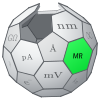



Analytically universal single device

| Written as | A.U.S.D. |
|---|---|
| Used by | Molecular Reality Corporation |
| Quest | 1,000 XP, switched off |
| Hardware sketch | The Ultra-Device of 2022 |
An analytically universal single device (A.U.S.D.) is an instrument that could measure and identify any molecule, cell or particle on its own, without a separate test for each target. Molecular Reality Corporation uses the phrase for the object of its research, and it offered the idea to its members as a quest worth 1,000 experience points, described as "Imagine an analytical universal single device! Let's discuss."[1][a] The quest has since been switched off, and the device it describes is the one that The Golden Blueprint is meant to specify.
Meaning
The 2022 statement of purpose, "Our North Star", requires of anything "worth deploying at utility-scale" that it have "universality", which it defines as "the ability to measure and identify any kind of cell or molecule".[2] A technical overview of the same year sharpens the requirement to mixtures: "being able to arbitrarily identify any given single analyte in a complex mixture using a single nanopore system". It grants that "a type of universality has already been achieved, by collective effort across eight decades", because "every isolated type of tiny thing has been measured in a pore-sensing-system at one time or another, from single ions measured in angstroms (tenths of nanometers) up to the scale of large plant cells measured in hundreds of micrometers".[3] The founder's essay for Epic Quest Bio calls "analytically universal sensors" "nearly synonymous with solid-state". The member software's welcome message limits the claim: "If it's either soluble in water or you can make it soluble, we want to build a single device that can 'see' it."[4]
Analytical chemistry has used the word before. Agilent's reference sheet for gas chromatography describes the thermal conductivity detector as a universal detector, one that can measure any sample component whose thermal conductivity differs from that of the carrier gas.[5] The chemist's universal detector has a condition too.
Why one pore is not enough
A particle that enters a pore blocks a fraction of the current, and for a particle much smaller than the pore that fraction is close to , where is the particle's diameter and and are the pore's diameter and length.[6] A particle 100 nm across in a hole 10 micrometers wide and as long changes the resistance by about one part in a million. In a hole 300 nm wide and as long it changes it by about 4 percent. The range in the overview, from angstroms to hundreds of micrometers, is six orders of magnitude or more in length and eighteen or more in volume. No single fixed pore gives a usable signal across that range, which is the argument for an adjustable pore, sliding occlusion, and for cartridges that swap one pore for another. See Coulter principle.
The 2022 overview pictures the result as the Ultra-Device: several thousand channels, each independently controllable, with "a completely different pore in each of those several thousand channels every half hour or so, with each pore being one of dozens of different types in dozens of different materials". It also allows that universality "only needs to go so far", since it is "fair game if we have to sort and filter materials on-device before they reach the pores".[3] The company's critique of its own machine-learning plans defines the word for the software: "'Universal' then means a shared analyte subspace, with the instrument-specific physics kept".[7]
Objections
A draft of the company's Disclosure Crawl ends with a skeptic's critique, written at the author's request, and one of its headings is "The 'Universality' Pipe Dream: A Single Sensor to Rule Them All?" Its argument is that "different molecules interact with their environment via fundamentally different forces and require different conditions for optimal detection", and that a universal sensor built from a library of cartridges is a return to specialization: "Cartridge Carousel or Back to Specialization?"[8]
The same draft states the hope in cruder terms. Solid-state sensors, it says, would put molecular sensing "into every toaster, every toilet, every tricorder", and a later passage speaks of turning future devices into "true 'tricorders' for the molecular realm". The Tricorder is the handheld scanner of Star Trek.[8]
See also
Notes
- ^ The quest says "analytical", where the company's tour and other materials say "analytically".
References
- ^ "Company records". Molecular Reality Corporation. October 2026.
- ^ "Our North Star: Utility-Scale Molecular Sensing". Molecular Reality Corporation. 2022.
- ^ a b Kemmishtree (March 28, 2026). "2022 sci-tech overview". EQBio-OS.
- ^ Kemmishtree (March 28, 2026). "welcome". EQBio-OS.
- ^ "Quick reference: GC detectors". Agilent Technologies. Retrieved October 25, 2026.
- ^ DeBlois, R. W.; Bean, C. P. (1970). "Counting and sizing of submicron particles by the resistive pulse technique". Review of Scientific Instruments 41 (7): 909. doi:10.1063/1.1684724.
- ^ "Keltar's Critique v2: The Nanopore World Model (Hardened)". Molecular Reality Corporation. August 2026.
- ^ a b "D&D: Disclosure Crawl (Dungeons & Diligence: Campaign Zero)". Molecular Reality Corporation. May 20, 2025.