Issue No. 4067 min read
Notes on demonpore, Two Pore Guys and Roswell
Three nanopore-adjacent startups had the best names in the business. All three changed them. One founder kept a list.
Ferris Calloway

This issue is about names, and it starts with a paper about mapping a bacterial genome.
In March, Kent Kemmish posted a short note on EQBio-OS, the members' site of his company, Molecular Reality Corporation. It was titled "Flossing with DNA", and it was meant to introduce a paper from a Santa Cruz group that had mapped the positions of tags along an E. coli genome by pulling the DNA back and forth between two solid-state pores.1 It did that, eventually. First it took a detour that I have been thinking about for seven months:
If you were paying any attention to genomic technologies in the past decade, you heard of Two Pore Guys, one of the three coolest/quirkiest names for a genomic tech startup ever, the other two being Roswell Biotechnologies (I was sooo jealous of this name!), and, of course, demonpore, inc..
The next paragraph opens: "Sadly, all three of us wimped out on our cool quirky names."
He is right about the outcome. Here are the three, in his order.
Two Pore Guys
Two Pore Guys was a University of California, Santa Cruz spinout, and the name came from a nickname for the research group that worked out the double-pore approach. In May 2019 it renamed itself Ontera, saying at the time that its platform used single pores as well as pairs. The post's verdict on the new name: "Two Pore Guys now has the ineffably unexciting name Ontera, Inc."
Kemmish also supplies the origin story, with a disclaimer attached: the company "was based on a premise initially explored by two literally poor academics (okay, it's not the best pun ever made, but it was wholesome)".2
The science behind the name is good and worth a paragraph. Put two pores a few micrometers apart, catch one DNA strand through both, and apply opposing forces so the strand sits under tension between them. Then move it back and forth past the pores. That is the flossing, and it lets the same stretch of DNA be read many times over. The Santa Cruz work, done with the Reisner lab at McGill as academic partner, used it to read the positions of large tags along a whole bacterial genome. Kemmish's gloss for newcomers is the best short description of genome mapping I know: "This is like being able to see the continents of Earth from space, so you know it's Earth and not another very similar planet, where actually sequencing would be like Google Maps."
He also notes, with what reads like real envy, how close the idea sits to his own company's. Demonpore's core idea was a pore whose size is set mechanically, by sliding one membrane over another. "It sounds so similar to demonpore's approach that you might wonder immediately, why did they almost do what we did, but not quite? They were just a few microns away from it!"
Roswell
Roswell Biotechnologies is the odd one in the list, because it does not use pores. It is a San Diego molecular-electronics company: its chips put single molecules, a DNA polymerase among them, into electronic circuits and read their activity as current. What it shares with the other two is the habit of reading biology electrically, one molecule at a time.
The name refers to the New Mexico town of the 1947 flying-saucer incident. In the post's words, "Roswell became, and this is painful to even say... 'Semicon Bio'".
demonpore
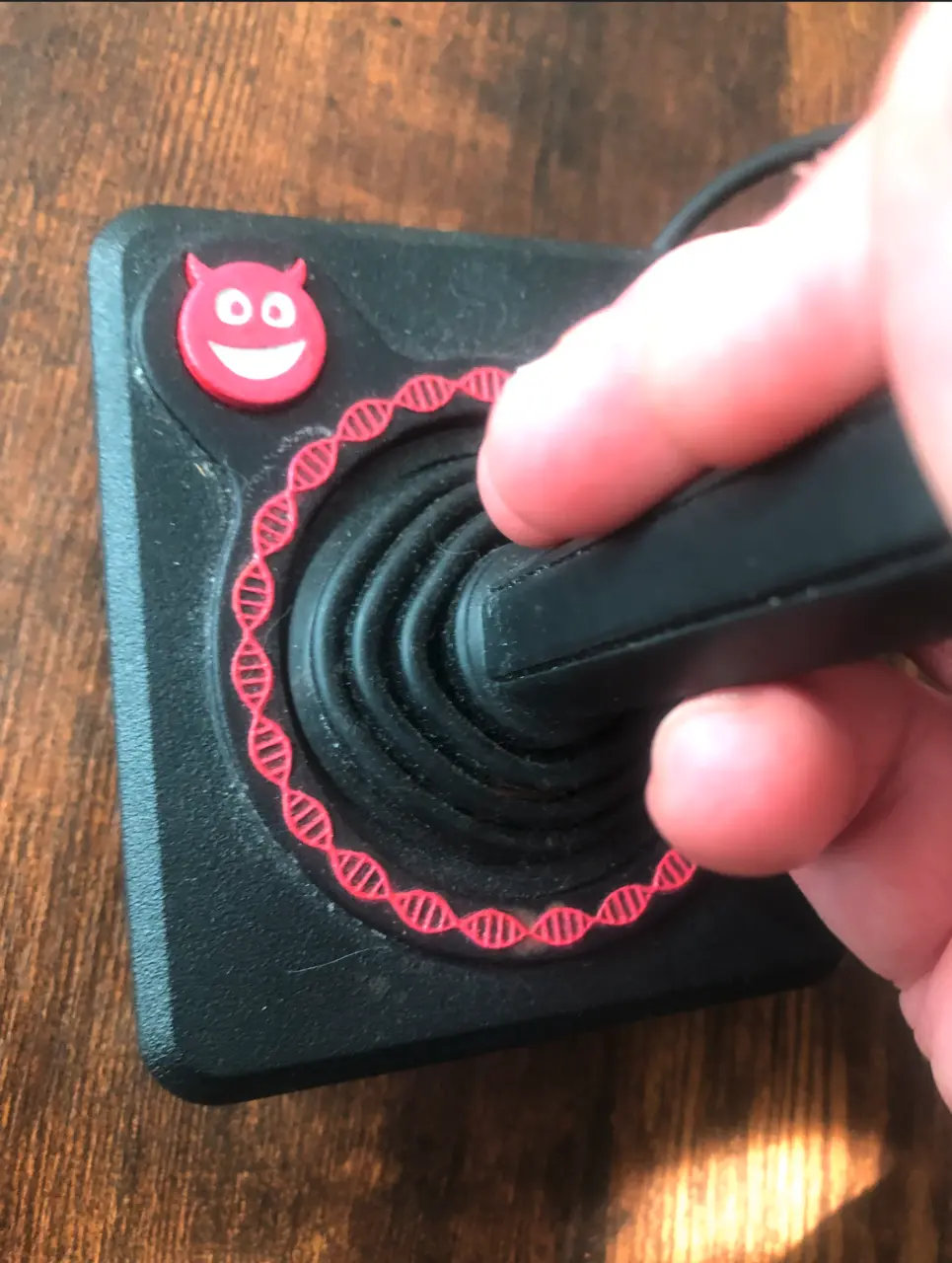
The third name is his own. His company, demonpore, inc., was founded in 2018 by Kemmish and Charles Gaillard, and it took its name from Maxwell's demon, the being in James Clerk Maxwell's 1867 thought experiment that opens and shuts a door between two chambers to sort fast molecules from slow ones. A pore that could open, close and change shape under control reminded a colleague of the cartoons that illustrate the demon. The company's red mascot, Maxine, tells the story in her own post: "Little cartoons explaining me inspired Molecular Reality Corporation's original name, demonpore inc.." She dates the first slide deck with the demon in it to "several thousand years ago in AEST (Accelerationist-Equivalent-Subjective-Time), i.e., around 2015."
In 2021 demonpore became Molecular Reality Corporation. The rename, the post says, was "my decision", and it gives the reason without softening it: "Instead, I was dealing with the fact that every time we had any sort of attention online, a bunch of insane people came out of nowhere to make veiled death threats. Sorry, you can't name a biotech startup after Maxwell's Demon in the age of Qanon."
The old name has not entirely gone away. The domain demonpore.com, registered on Christmas Eve 2014, still loads the company's front page, and the company FAQ, written in the voice of a felt puppet, calls it "an old name I mention exactly once in this entire guide." It keeps the promise.
A fourth name
The list in the post stops at three, but the same members' site carries a fourth, and it belongs in any honest account of nanopore startups and their names. Aipore was an Osaka University venture, founded in 2018, that paired solid-state nanopores with machine learning to identify viruses and other particles by the shape of their current pulses. Kemmish's journal-club note on the paper behind it is admiring: they "built a startup called AIpore that actually shipped a working product." Osaka University's list of its startups now says the company "concluded its activities in 2025".3 Its instrument went on sale, and the university says a COVID-19 test built on it was validated on more than 10,000 clinical samples. That is more than most companies in this newsletter's beat have done under any name.
The biggest company in the field, Oxford Nanopore, reads DNA and RNA with engineered protein pores, the current ones derived from a bacterial protein called CsgG, set in a synthetic polymer membrane, with a motor protein to ratchet each strand through. Molecular Reality's own quiz game, JeoPOREdy!, has a clue about it, and the commentary written for its host is generous: "ONT is our kin-spirit in many ways, dear nanopioneer."
Molecular streaming
One more name, and this one Molecular Reality still uses. Its word for what it does is molecular streaming: molecules stream through a sensor, and the data streams out to whoever wants to watch. On March 28, in a post titled "Marching orders", the founder wrote that "Nobody outside the corps calls it molecular streaming yet," the corps being the company's community of "player scientists". He cited one related use he had found, "ionic streaming", in a paper he gave as Keerthi et al. 2021.
The phrase is older than that, and it is someone else's title. In 2019 Nature published "Molecular streaming and its voltage control in ångström-scale channels" by Mouterde, Keerthi and colleagues, from the Manchester and Paris groups that build slits a few atoms tall out of graphite and boron nitride.4 There, molecular streaming means salt water pushed through those slits by pressure, and the paper's result was that a bias of a fraction of a volt raised the streaming mobility up to 20 times. Its second author is A. Keerthi, of the same Manchester group the March post credits with "ionic streaming". The two uses of the phrase mean different things.
So the score is three renames, one company that closed, and one term of art that a 2019 paper had already put in its title. Kemmish has a line that covers this, from another post, about why he calls a paper's method "Mambapore": "because I'm a verbal anarchist."
Debye Length is written by one person and goes out when there is something to say.5
- Rand et al., "Electronic Mapping of a Bacterial Genome with Dual Solid-State Nanopores and Active Single-Molecule Control", ACS Nano 16:5258 (2022). Most of the authors were industry scientists in Santa Cruz; the Reisner lab at McGill was the academic partner.
- Molecular Reality's members-only quiz, JeoPOREdy!, has a clue on the subject: "Founded in 2011 with a tongue-in-cheek name, this UC Santa Cruz spinout built a handheld solid-state nanopore sensor using a pair of pores to control DNA motion." The answer is "What are Two Pore Guys?"
- The university describes Aipore as a venture that built a measurement system combining nanopores with AI, and credits Professor Masateru Taniguchi of its Institute of Scientific and Industrial Research with founding it. The science it built on includes Arima et al. (2018), from the Taniguchi lab, which told virus serotypes apart from single translocations.
- T. Mouterde, A. Keerthi, A. R. Poggioli, S. A. Dar, A. Siria, A. K. Geim, L. Bocquet and B. Radha, "Molecular streaming and its voltage control in ångström-scale channels", Nature 567:87-90 (2019), doi:10.1038/s41586-019-0961-5.
- The Debye length is the distance over which ions in a solution screen out a charge. In 1 M potassium chloride, the usual nanopore electrolyte, it is about 0.3 nm. In 1 mM it is about 10 nm.